|
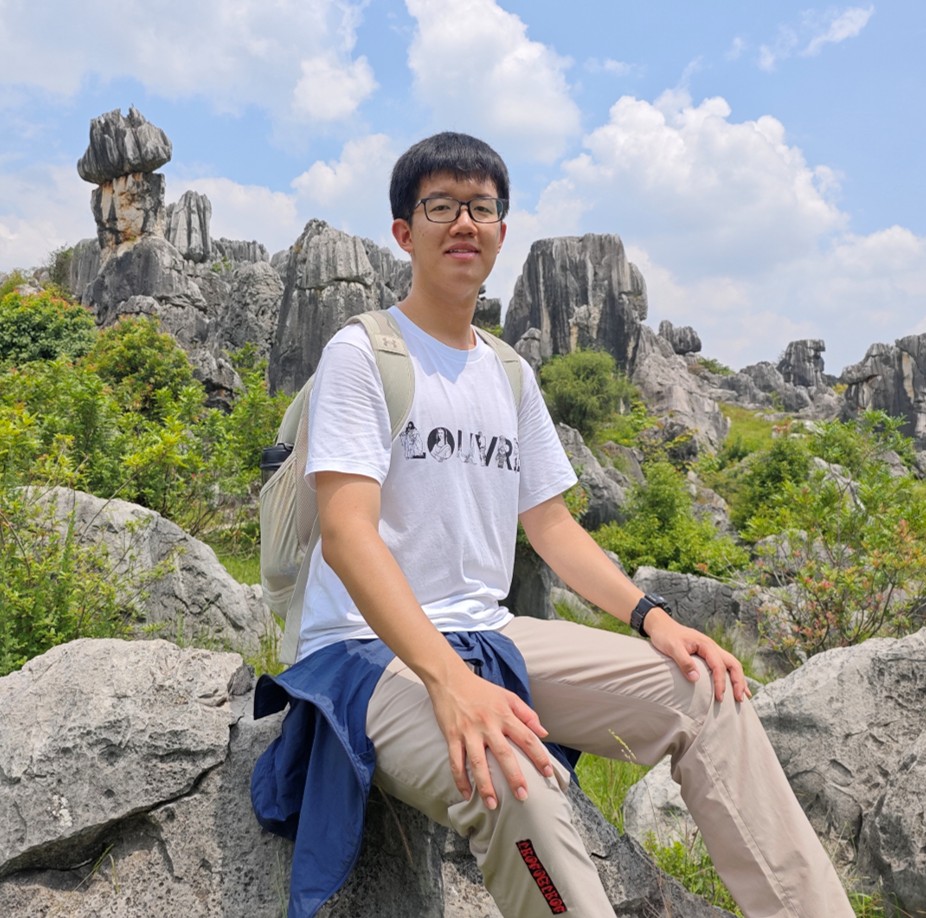
Hi, I am currently a M.E. student at Future Intelligence laB (FIBLAB), in Department of Electronic Emgineering, Tsinghua University. I am advised by Prof. Yong Li and Prof. Yue Wang. My research focus lie in generative AI, mobile computing, and wireless-network world models. In the future, I plan to explore broader applications of world models, including vision- and embodiment-related scenarios such as video generation and robotic control. Before that, I received my B.S. from Beijing Institute of Technology in 2024. I also completed a minor degree in Economics at Peking University in 2024. I always welcome discussions and collaborations on future mobile networks and world models! |
|
|
🎉 Sept. 2, 2026: Our paper Physics-informed Diffusion Models for Multi-scale Prediction of Reference Signal Received Power in Wireless Networks has been accepted to 📄 IEEE Transactions on Mobile Computing (CCF-A, IF=8.8). 🎉 Aug. 25, 2026: Our paper MobileCN: A Large-Scale Synthetic Gridded Cellular Network Dataset of Active User Counts and Downlink Traffic in China has been accepted to 📄 Nature Scientific Data (IF=7.2). 🎉 Aug. 23, 2026: Our paper Denoising Refinement Diffusion Models for Simultaneous Generation of Multi-scale Mobile Network Traffic has been accepted to 📄 IEEE Transactions on Mobile Computing (CCF-A, IF=8.8). 🎉 Jul. 22, 2026: Our paper Reinforcement Learning in the Era of Large Language Models: Challenges and Opportunities has been accepted to 📄 ACM Computing Surveys (IF=30.4). 🎉 Dec. 5, 2025: Our paper MobiFM: A Foundation Model for Mobile Data Forecasting has been accepted to 📄 IEEE Journal on Selected Areas in Communications (CCF-A, IF=17.2). 🎉 May 23, 2025: Our paper UoMo: A Universal Model of Mobile Traffic Forecasting for Wireless Network Optimization has been accepted to 🎙️ ACM SIGKDD 2025 (CCF-A). 🎉 Jan. 3, 2025: Our paper Spatio-Temporal Knowledge Driven Diffusion Model for Mobile Traffic Generation has been accepted to 📄 IEEE Transactions on Mobile Computing (CCF-A, IF=8.8). 🎉 Aug. 21, 2024: Our paper Regional features conditioned diffusion models for 5g network traffic generation has been accepted to 🎙️ ACM SIGSPATIAL 2024 (CCF-C). |
|
My research interests lie in generative AI, mobile computing, and wireless-network world models. I proposed MobiFM, the first foundation model for mobile networks, and MobiWM, the first practical wireless-network world model designed for mobile traffic modeling. Representative works are highlighted. |
|
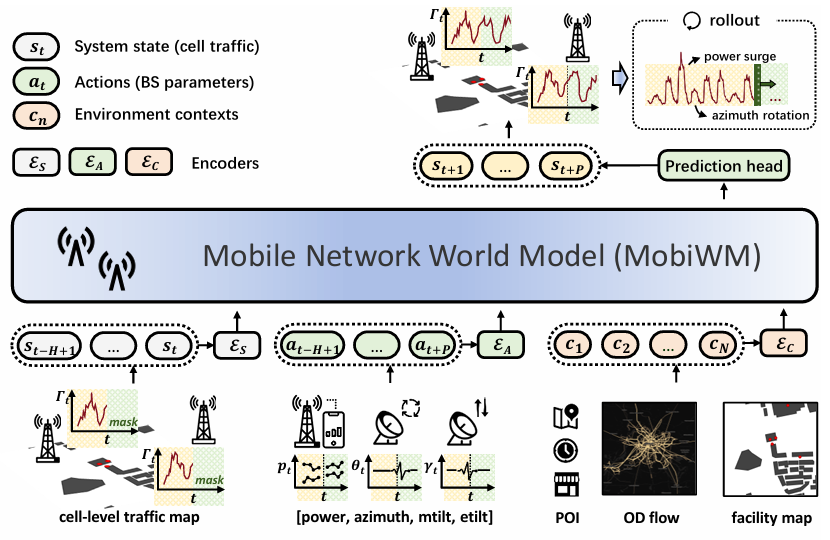
Xiaoqian Qi, Haoye Chai, Yue Wang, Yong Li, arXiv , 2026 We propose MobiWM, a world model for mobile networks that captures the dynamics between mobile traffic states and network parameter actions (power, azimuth, tilt). By fusing multimodal environmental contexts with encoded actions, MobiWM supports unlimited-horizon rollout and serves as an explorable counterfactual simulation environment for network planning and optimization. |
|
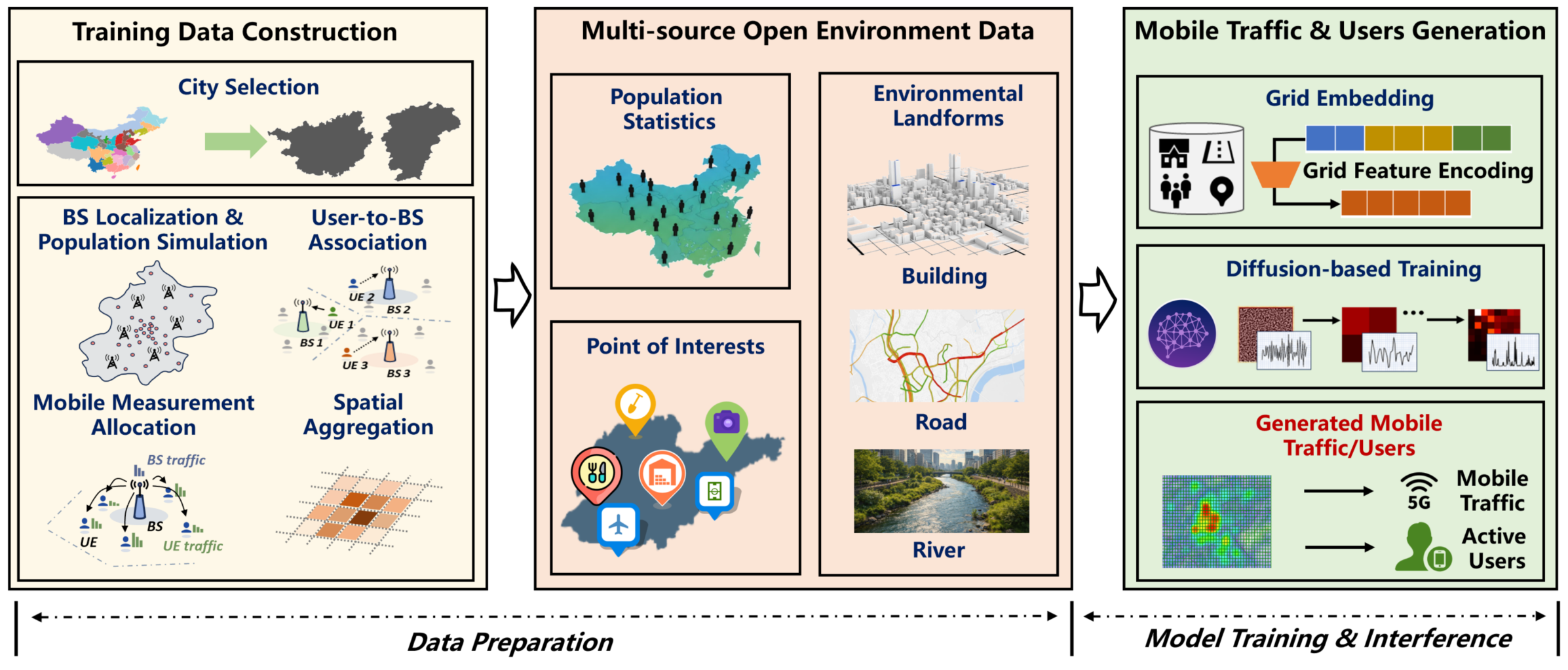
Haoye Chai*, Xiaoqian Qi*, Yuming Lin, Mugen Peng, Yong Li, Nature Scientific Data , 2026 We introduce MobileCN, a large-scale synthetic mobile network dataset that generates high-fidelity active user and traffic dynamics across 40 Chinese cities by conditioning multi-resolution diffusion models on multimodal urban environments, providing a privacy-preserving and extensible data foundation for mobile network planning, urban computing, and sustainability research. |
|
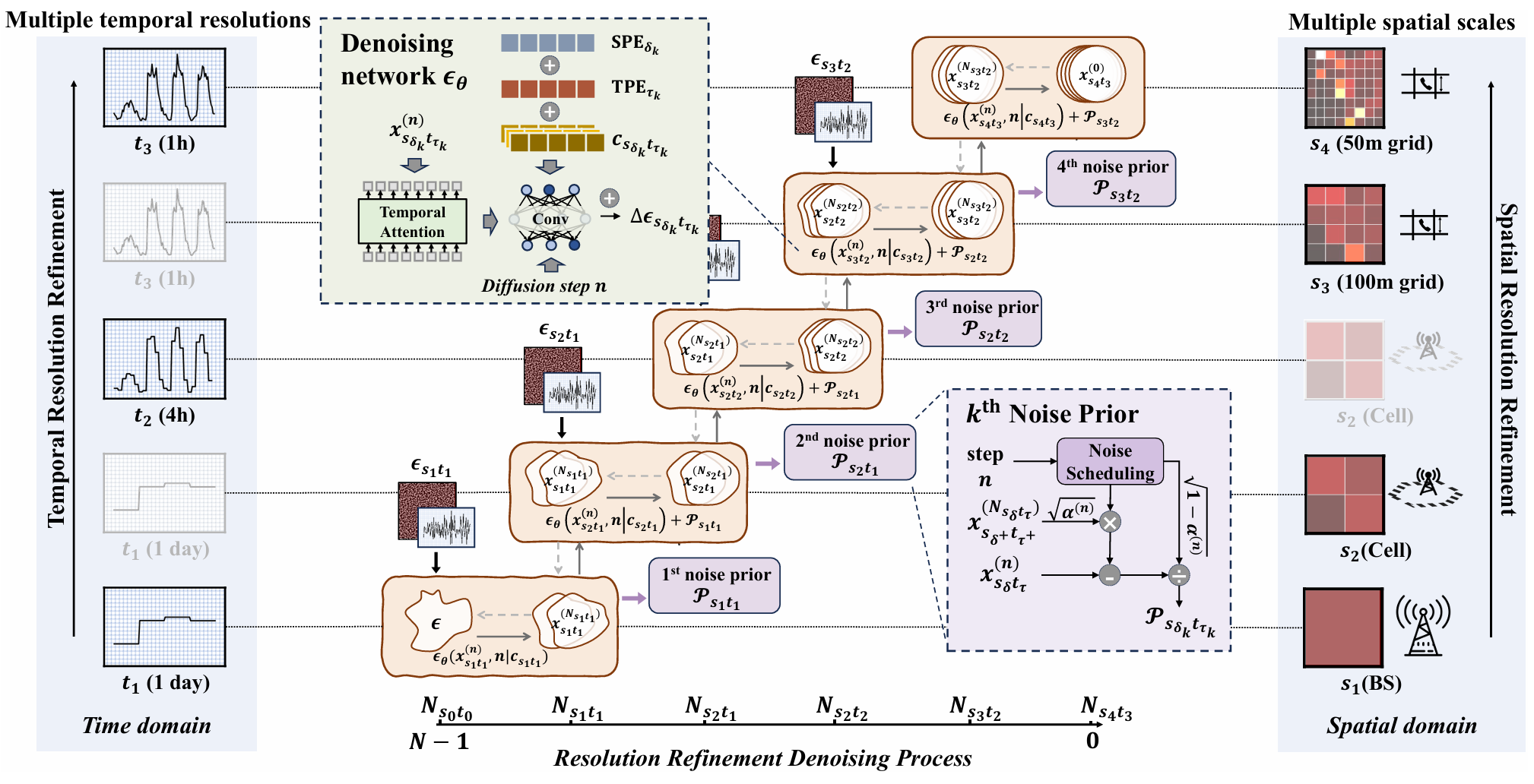
Xiaoqian Qi, Haoye Chai, Sichang Liu , Lei Yue , Raoyuan Pan , Yue Wang , Yong Li IEEE Transactions on Mobile Computing (TMC) , 2026 We introduce ZoomDiff, a denoising refinement diffusion model that simultaneously generates mobile network traffic across multiple spatial and temporal resolutions. By aligning a progressive noise-removal mechanism with hierarchical network layers, ZoomDiff improves fidelity over prior methods by at least 18.4% and generalizes across cities. |
|
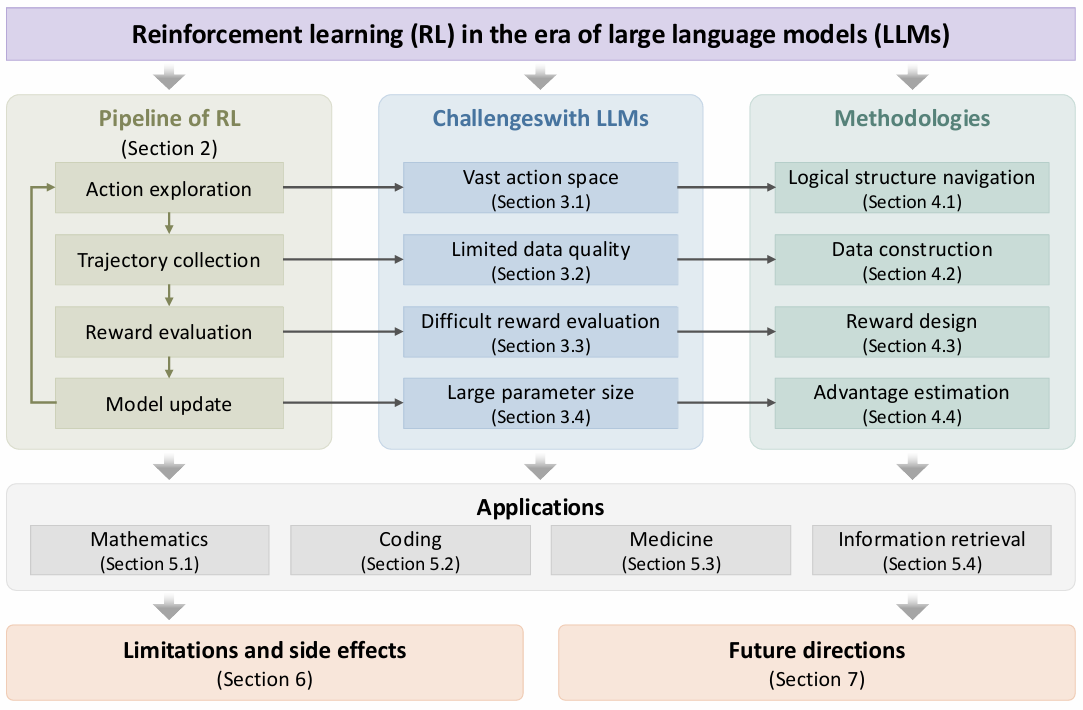
Qianyue Hao, Lin Chen , Xiaoqian Qi, Yuan Yuan, Zefang Zong, Hongyi Chen, Keyu Zhao, Shengyuan Wang Yunke Zhang Jian Yuan Yong Li ACM Computing Surveys, 2026 A comprehensive survey of how reinforcement learning interacts with large language models, reviewing recent progress in RL-based LLM training, fine-tuning, and alignment, and outlining shared challenges and emerging research opportunities at this intersection. |
|
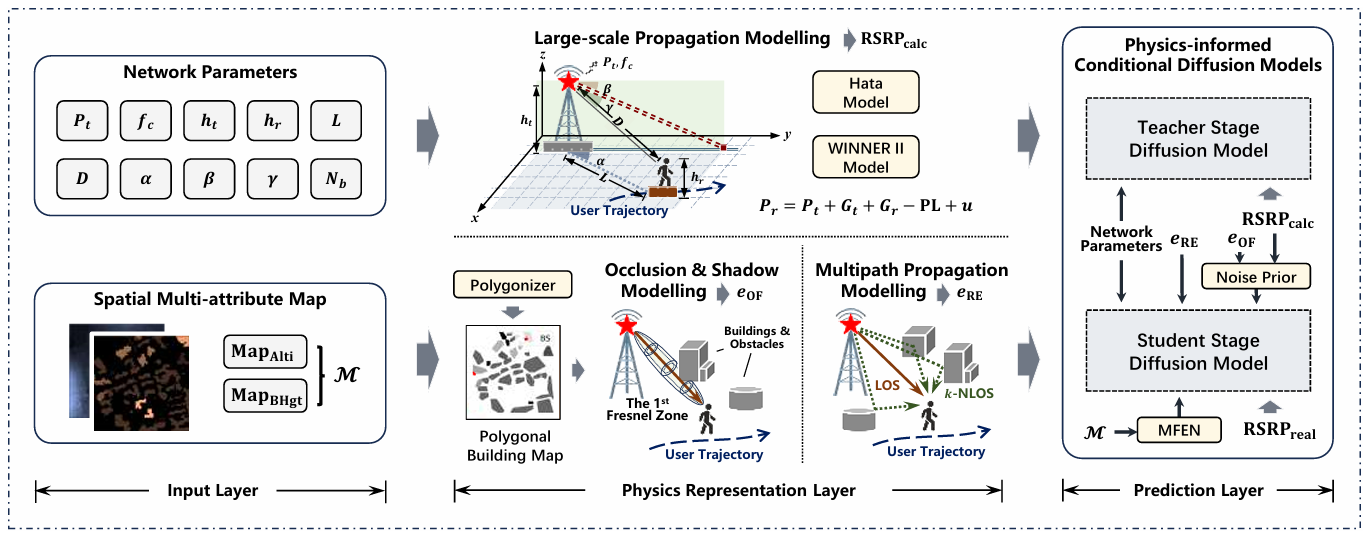
Xiaoqian Qi, Haoye Chai, Yue Wang, Zhaocheng Wang, Yong Li IEEE Transactions on Mobile Computing (TMC), 2026 We propose Channel-Diff, a physics-informed conditional diffusion framework for Reference Signal Received Power (RSRP) prediction. By integrating large-scale and small-scale propagation priors via a two-stage training scheme with noise prior guidance, Channel-Diff achieves 25.15%–37.19% accuracy gains and strong transferability across multi-scale wireless channels. |
|
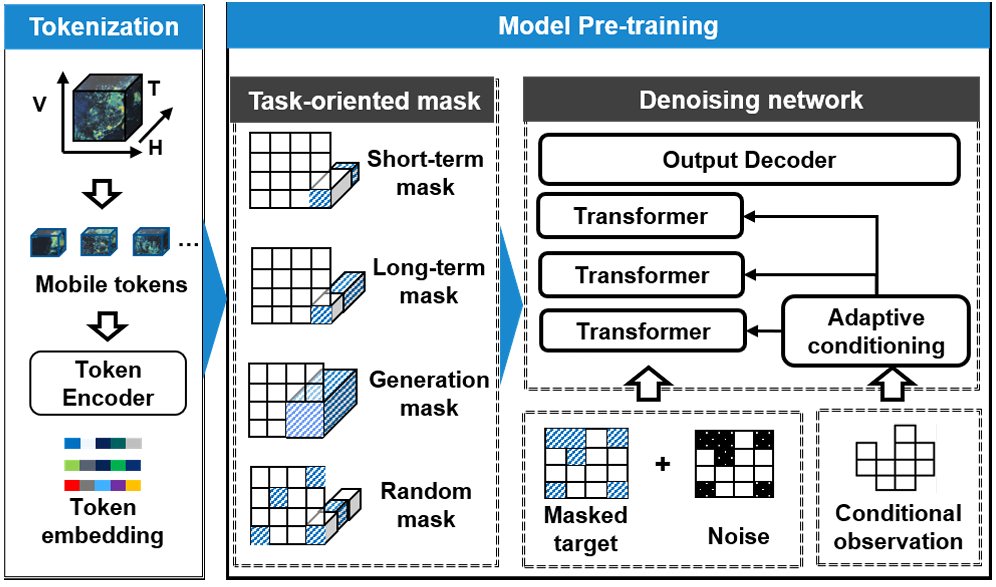
Haoye Chai, Xiaoqian Qi, Yibo Ma, Zhaocheng Wang, Lei Yue, Yong Li IEEE Journal on Selected Areas in Communications (JSAC), 2025 We present MobiFM, a unified foundation model for mobile data forecasting built on diffusion and Transformer backbones. MobiFM jointly handles diverse data types (traffic, users, wireless channel), multiple time granularities, and varied spatial scales (cell- and grid-level) within a single framework, eliminating the cost of task-specific predictors. |
|
Haoye Chai, Shiyuan Zhang, Xiaoqian Qi, Baohua Qiu , Yong Li ACM SIGKDD , 2025 We propose UoMo, a universal mobile-traffic forecasting model that unifies diverse downstream tasks—base station deployment, resource allocation, energy optimization—within a single framework with zero/few-shot adaptability. Real-world deployments yield 25.3% more served users and 40.7% lower equipment depreciation. |
|
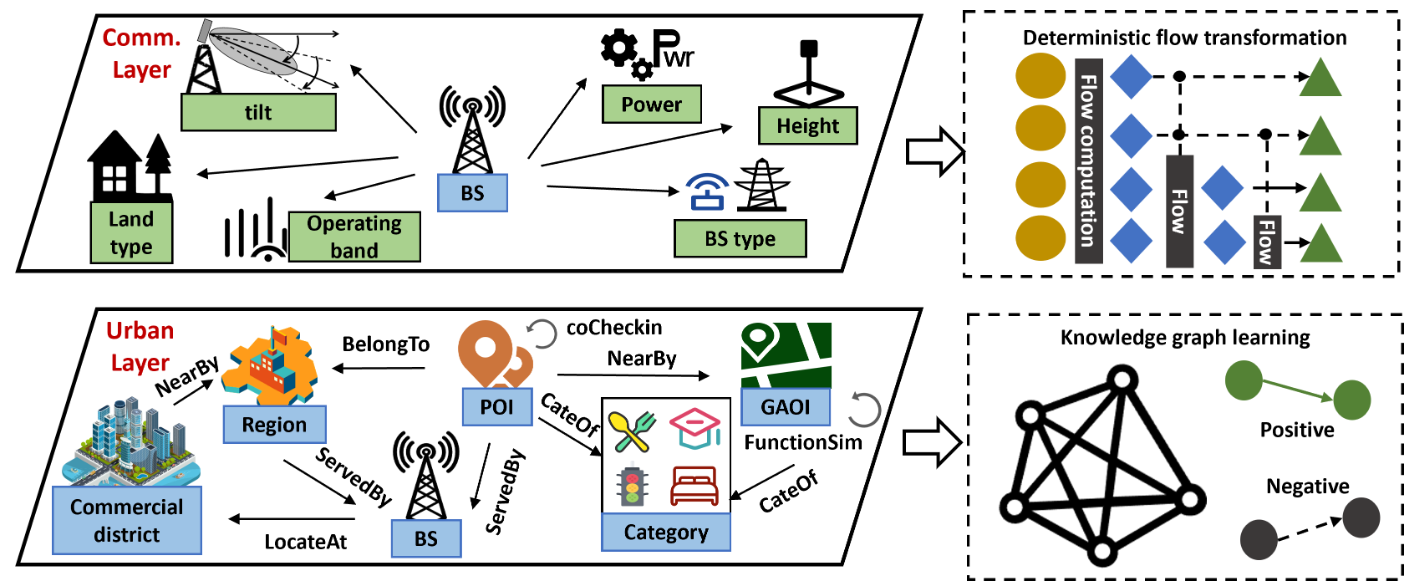
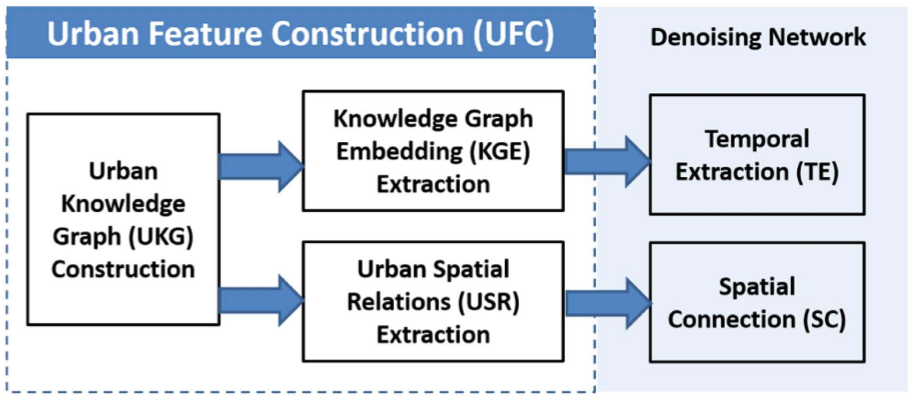
Haoye Chai, Xiaoqian Qi, Yong Li IEEE Transactions on Mobile Computing (TMC), 2025 We propose STK-Diff, a spatio-temporal knowledge-driven diffusion model for controllable mobile traffic generation. Built on an Urban Knowledge Graph that encodes spatial-semantic relations among base stations, business areas, and functional regions, STK-Diff improves controllability by over 15%. |
|
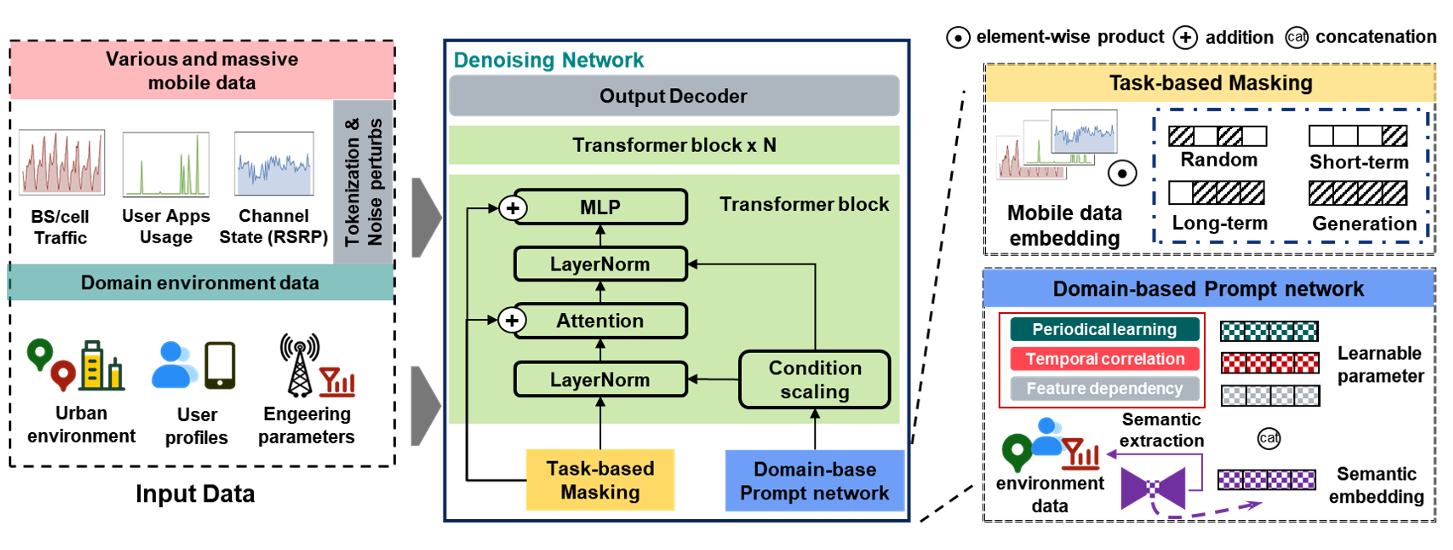
Xiaoqian Qi, Haoye Chai, Yong Li arXiv, 2025 We design MobiGPT, a foundation model for mobile data forecasting with a unified structure across base station traffic, user app usage, and channel quality. With soft-prompt learning and a temporal masking mechanism, MobiGPT supports short-term, long-term, and distribution-generation tasks, improving accuracy by 7%–27% and zero/few-shot transfer by over 21%. |
|
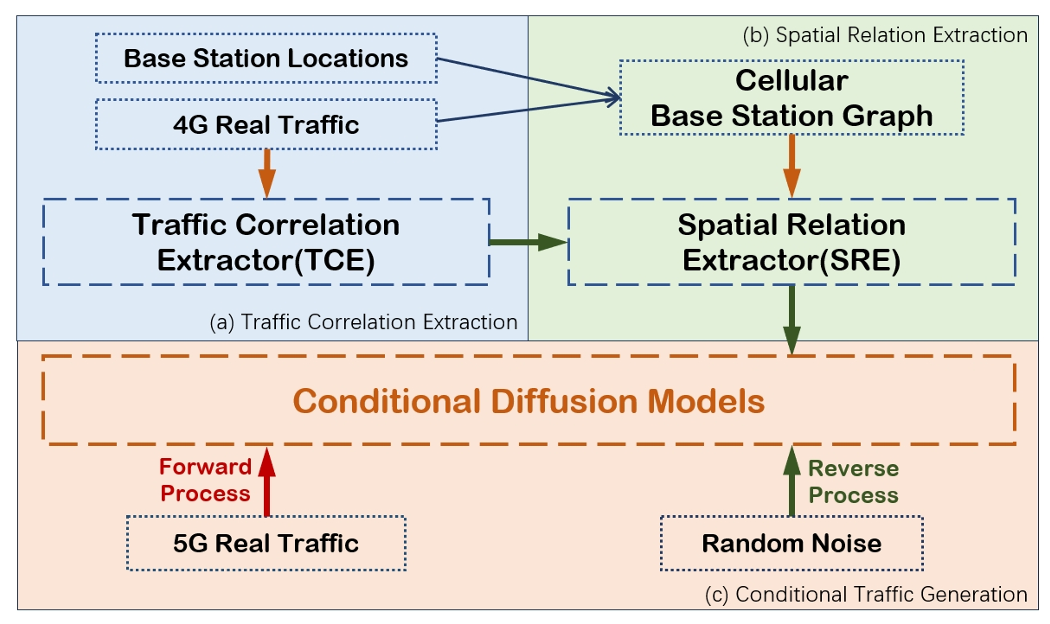
Xiaoqian Qi, Haoye Chai, Li Yu, Yong Li, Zhaocheng Wang ACM SIGSPATIAL, 2024 We propose CANDLE, a regional-feature conditioned diffusion framework for 5G network traffic generation. Leveraging cross-attention and graph convolutional networks, CANDLE captures correlations between 4G and 5G traffic together with regional features, enabling high-fidelity 5G traffic synthesis in target regions with insufficient coverage and limited historical data. |
|
🏅 National Scholarship, 2025. (From THU) 🎗️ Outstanding Student Leader, 2025. (From THU) 🏅 National Scholarship, 2023. (From BIT) 🏅 National Scholarship, 2022. (From BIT) 🏅 National Scholarship, 2021. (From BIT) |
|
This website template is borrowed from Jon Barron. Thanks! |